
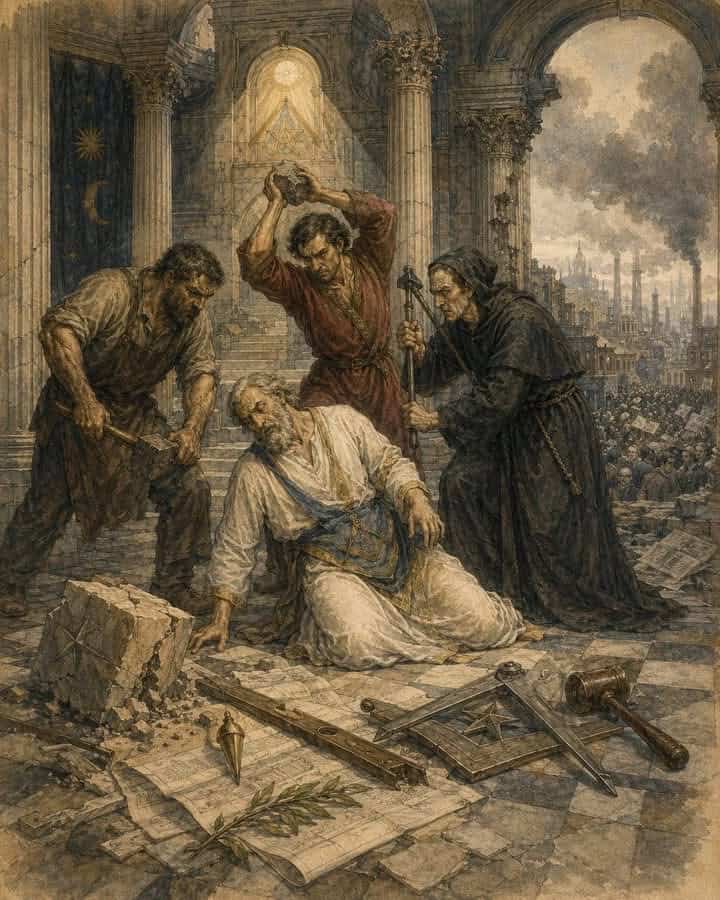
An allegory of the temple within.
The legend at the heart of the Master Mason’s degree tells of a builder betrayed. Hiram Abiff, the architect of the Temple, is set upon by three workmen who demand the secrets he is sworn to guard. He refuses each in turn. Each strikes him. The third blow ends his life, and the unfinished Word is lost beneath the rubble of the unfinished house.
We are taught to read this as history, and to mourn it as tragedy. But the older teaching is harder, and far nearer. The Temple was never only in Jerusalem. It is the Temple of Man. And the three ruffians are not strangers waiting at the gates of a distant city. They live within.
The Temple of Man
The Three Ruffians stand within the Temple of Man.
Every soul is raised as a structure is raised — by plan, by measure, by labor proportioned to a design it did not invent. Wisdom contrives it, Strength supports it, Beauty adorns it. The higher faculties are meant to govern; the lower nature is meant to serve. When that order holds, the building rises toward the light, and the Word lives at its center.
But the workmen who labor on the Temple are also the ones who can ruin it. The same hands that lift the stone can let it fall. This is the secret of the legend: the assassins wear the apron. They are not invaders. They are insiders who turned against the work.
The First Ruffian: Ignorance
Ignorance darkens the inner chamber, until the soul forgets the design by which it was made.
This is the first and most patient of the three. It does not need to lie; it only needs to leave the lamp unlit. In the darkened chamber a man cannot read his own plans. He forgets that he is a building meant for something, and begins to mistake the rubble for the architecture. He calls confusion freedom and calls his blindness a point of view.
Ignorance does not strike to kill. It strikes to disorient — to make the second and third blows possible. Where it rules, every other vice finds shelter, because nothing can be named for what it is.
The Second Ruffian: Ambition
Ambition seizes the tools of labor and turns them from service to dominion.
The tools were given for building. The gavel shapes the rough stone; the compass keeps the work within due bounds. Ambition takes these same instruments and reverses their purpose. It no longer asks what the work requires, only what the self can seize. The implement of discipline becomes a weapon of conquest.
This is the deeper treachery, because ambition counterfeits virtue. It wears the look of greatness. It speaks of legacy, of vision, of deserving. But it has quietly moved the center of the Temple from the design to the builder — and a Temple built to glorify its mason will not stand.
The Third Ruffian: Fanaticism
Fanaticism strikes the final blow, hardening zeal into violence and calling its own blindness holy.
This is the most terrible, because it borrows the language of the light to do the work of the dark. Ignorance forgets the design; ambition betrays it; fanaticism declares that it alone defends it. It takes conviction — which should be the soul’s fidelity to truth — and strips it of humility, of mercy, of proportion. What remains is certainty without sight, and certainty without sight will always reach for the blow.
Fanaticism is zeal that has stopped serving and started ruling. It no longer seeks the Word; it believes it already possesses it, entire and beyond question. And so it silences every voice that might correct it, and calls the silencing sacred.
The Death of the Master Builder
Thus Hiram is slain whenever the higher faculties are betrayed by the lower nature.
Wisdom is silenced. Beauty is defaced. Strength is made brutal. The virtuous desire, which would raise the mind toward the East, is dragged down into the dust of appetite, vanity, and rage. The columns that should support the soul are turned against it. The plumb no longer measures uprightness; the level no longer remembers equality; the square forgets the angle of honest dealing.
When the Master Builder falls, the Word is not destroyed — it is buried. It lies beneath the ruins of the man he was meant to be. And that is the whole of the loss: not that truth has died, but that it has been covered over, and waits.
When the Ruffians Become Rulers
The tragedy of the Master Builder is therefore enacted in every age and in every breast. The temple falls first within, and afterward upon the earth.
This is why the legend never grows old. The three ruffians are not relics of a single crime. They are the standing temptations of the human heart, repeated wherever a soul lays down its tools. And what begins privately does not stay private. The disorder a man permits within himself, he eventually builds into the world around him.
When men enthrone ignorance as opinion, ambition as greatness, and fanaticism as truth, the ruffians are no longer fugitives. They become rulers.
Modernity has given them vast instruments: voices without wisdom, power without proportion, conviction without light. Never before has ignorance been amplified so loudly, ambition rewarded so swiftly, or fanaticism armed so easily. The same age that multiplied our tools failed to multiply our discipline — and the tools, as ever, turn against the builder who will not govern himself. Their dominion spreads wherever the soul refuses discipline.
The Work
And yet the work remains. It is the only thing the ruffians cannot take, because it is the one thing they cannot perform.
The work remains what it has always been: to recover the buried Word within the ruins of ourselves, and to raise again the slain principle by purity of heart, rectitude of conduct, and fidelity to the Light.
This is not done by overthrowing some enemy in the world. It is done by relighting the inner chamber, so that ignorance has nowhere left to hide. It is done by returning the tools to their proper use, so that ambition is starved of its instruments. It is done by binding zeal once more to humility, so that conviction serves the light instead of usurping it.
The Temple falls within, and so it must be rebuilt within. Stone by patient stone, the Master Builder is raised again — not once, in a story, but daily, in a life. That is the labor we are given. It is enough to fill a lifetime, and it is the only work that finally matters.